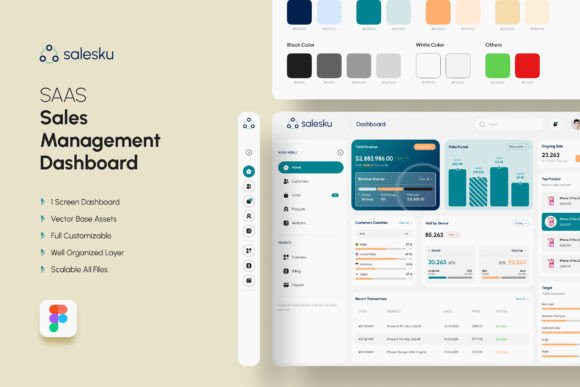
Sales Management System Admin Dashboard
In the fast-paced world of digital business, the clarity of your data determines the speed of your decisions. A robust Sales Management System Admin Dashboard serves as the central nervous system for any organization aiming to streamline operations and drive growth. Whether you are managing a small e-commerce store or a complex corporate enterprise, the interface you choose dictates how efficiently your team interacts with critical information. This specific dashboard template is not merely a visual layout; it is a comprehensive design solution engineered to support a wide array of web applications, including custom admin panels, CMS platforms, CRM systems, SAAS products, HRMS, support portals, and social networks.
The primary value of this tool lies in its versatility and professional execution. Designed within Figma, it offers a clean, organized structure that allows developers and designers to focus on functionality rather than fighting with disorganized layers. For professionals ranging from entrepreneurs to freelance creators, having a reliable foundation can significantly reduce development time and improve the final user experience. By leveraging a pre-structured environment, teams can allocate more resources to refining their unique business logic and less on building basic UI components from scratch.
Streamlining Complex Data Visualization
One of the most significant challenges in building web applications is presenting complex data in a digestible format. A well-designed Sales Management System Admin Dashboard addresses this by offering intuitive layouts for key metrics. The template includes essential views such as a main dashboard overview, a calendar for scheduling and planning, and a mail note section for communication management. These elements are crucial for maintaining operational flow.
Consider a scenario where a marketing team needs to track campaign performance alongside sales figures. Without a structured interface, they might rely on disparate spreadsheets or clunky reports. With this dashboard, the integration of data points becomes seamless. The clean organization ensures that critical KPIs are immediately visible, allowing managers to spot trends or anomalies without digging through nested menus. This clarity supports better decision-making, enabling leaders to pivot strategies quickly when market conditions change.
Technical Precision for Professional Development
For developers and UI/UX designers, the technical specifications of a design file are just as important as its aesthetic appeal. This template is built with high standards in mind, ensuring compatibility across modern workflows. It utilizes RGB color mode at 150 dpi, which is optimal for screen-based applications. Furthermore, the use of vector shapes guarantees that every element remains crisp and sharp, regardless of the screen resolution, making it fully Retina Ready.
The file structure is meticulously organized, featuring fully layered components that make editing straightforward. Every asset is clearly labeled, reducing the time spent searching for specific elements during the handoff phase. This level of organization is particularly beneficial for collaborative projects where multiple stakeholders need to access and modify the design. When working on large-scale projects like a corporate HRMS or a multi-vendor e-commerce platform, the ability to quickly locate and adjust a specific button or chart can save hours of frustration.
Customization and Brand Consistency
A major advantage of this Sales Management System Admin Dashboard is its flexibility. Businesses often struggle to find templates that align with their brand identity without requiring extensive redesign work. Here, changing colors, shapes, and effects is an intuitive process. The template uses only free fonts from Google Fonts, eliminating licensing concerns while ensuring excellent readability and cross-platform consistency.
This ease of customization is vital for agencies and freelancers who serve diverse clients. For instance, a developer creating a support portal for a tech startup can instantly swap the color palette to match the client's branding guidelines. Similarly, a team building a personal business dashboard can adjust the assets to reflect a more casual, approachable tone. The ability to adapt the design without compromising its structural integrity means that the final product feels bespoke rather than generic.
Broad Applicability Across Industries
The true power of this template is its agnostic nature. While named as a Sales Management System Admin Dashboard, its architecture is robust enough to support virtually any type of web application. This makes it an ideal choice for a variety of sectors:
- E-commerce: Merchants can utilize the dashboard to monitor inventory levels, track order statuses, and manage customer interactions in real-time.
- SAAS and CRM: Software companies can deploy this interface to provide their users with a clean, efficient way to manage accounts and view analytics.
- HRMS and Corporate: Human resources departments can leverage the calendar and mail note features to handle employee schedules, leave requests, and internal communications.
- Support and Social Portals: Community managers can use the organized layout to moderate content, track user engagement, and respond to inquiries efficiently.
This versatility means that a single investment in the design can yield returns across multiple projects. Instead of purchasing different templates for a CRM and a blog CMS, teams can adapt this one resource to fit both needs, ensuring a consistent look and feel across their digital ecosystem.
Enhancing Team Collaboration and Efficiency
Effective communication between design and development teams is often the bottleneck in software projects. Disorganized files lead to misinterpretations, missed details, and rework. The Sales Management System Admin Dashboard mitigates these risks through its very clean and organized structure. Because all documents are clearly arranged and labeled, the transition from design to code is smoother.
Developers can easily inspect layers to understand spacing, typography, and interaction states. This transparency fosters a collaborative environment where designers and coders speak the same language. For startups operating with lean teams, this efficiency is invaluable. It allows a small group to produce high-quality outputs that would typically require a larger workforce. By removing the friction of messy design files, teams can focus on solving actual business problems rather than debugging UI inconsistencies.
Practical Considerations and Limitations
While this template offers significant advantages, it is important to understand its scope. The file provided is a Figma design asset (1920 w × 1665 h px) intended for the creation of interfaces. It does not include backend functionality, database connections, or live images. All images shown in previews are for illustrative purposes only and are not part of the download. Users must integrate their own assets and connect the design to their chosen technology stack.
Additionally, while the template is highly customizable, it assumes a baseline level of proficiency with Figma. Teams unfamiliar with the tool may need a brief learning curve to fully exploit the layered structure and component properties. However, given the industry standard status of Figma, this is a minor hurdle for most professional environments. It is also worth noting that while the layout is responsive-ready in concept, the actual implementation of mobile breakpoints will depend on the developer's coding skills during the build phase.
Driving Better Business Outcomes
Ultimately, the goal of any admin panel is to facilitate better business outcomes. A Sales Management System Admin Dashboard that is easy to navigate and visually clear reduces cognitive load for users. When employees spend less time figuring out how to use the system, they spend more time executing their core responsibilities. This leads to increased productivity, higher accuracy in reporting, and faster response times to customer needs.
For entrepreneurs and small business owners, the ability to present a professional interface can also enhance credibility. Whether showing the dashboard to investors, partners, or end-users, a polished design signals competence and attention to detail. It transforms raw data into actionable insights, empowering stakeholders to see the bigger picture and make informed strategic choices.
In conclusion, this professionally created Figma template represents a practical solution for modern web application development. By combining technical precision with flexible design, it empowers professionals to build superior admin panels, CRMs, and dashboards across various industries. Its clean organization, easy customization, and broad applicability make it a valuable asset for anyone looking to elevate their digital projects and achieve meaningful results.